
Fortunately this story has a happy ending. Apple realized it was a mistake and decided to refund the Kitchens. However, there's a lot of lingering questions. How could this happen, and more importantly, how can you prevent it from happening to you?
The blame obviously lies with the parents themselves. Apple had emailed them an itemized invoice for 70 pounds the next day. They ignored it assuming it was sent in error. In fact it's likely the spree would have continued had the Kitchens' credit card company not called. That's mistake number one. Any charge that you did not make on your credit card should always be cause for alarm. ALWAYS check your receipts. I can't stress this enough.
The second mistake was allowing a five year old unsupervised access to the family computer. Kids are a lot smarter than we adults tend to give them credit for. It's truly amazing how much trouble they can make in such a short time. Especially when you give them the means to buy things when the child has no concept of money.
"Free" games targeted at young children frequently use micro-transactions for in-game items. These items range for $1 all the way up to $100 or more for something as stupid as a "Trunk of Diamonds" in one particular farming simulator. The kid is smart enough to know that more resources make the game easier. What they don't know is these items cost mommy and daddy real, finite money.
Lucky for you, it's very easy to protect yourself from what's happened to the Kitchens and countless others.
1. Never let kids use the computer unsupervised.
Don't treat it as a babysitting tool. If your child wants to play a game, play it with them. As any parent knows, kids that young can start a world of trouble if you take your eyes off them. For the love of god never share your passwords with your children either. Heck I can remember hacking my dad's user account when I was eight because his password was too obvious.
2. Familiarize yourself with your computer's security and parental controls.
It's amazing how many people rely on technology to run their lives, but are still technologically illiterate.
In iOS, under the settings tab, go into General and click restrictions These are your parental controls. The list labelled "Allowed Content" is what you're interested in. Particularly the two at the bottom. By default, iOS allows in-app purchases and waits 15 minutes before requiring a password to buy and download new content from the App Store. You'll want to set these to OFF and IMMEDIATELY respectively. This will prevent kids from accidentally buying things without your permission.
 |
| Turn off "In-App Purchases" and set Require Password to "Immediate" to prevent accidental charges |
The biggest problem with iOS is you can't set up separate accounts for different users. HOWEVER, what you can do is set up multiple iTunes Store accounts which can be used on a single device.
It's very easy and requires about five minutes of your time. Sign out of iTunes on your computer, then hit sign in and select "Create Apple ID". Don't tie a credit card to this account. Just select "none" as your payment method. Now that your kid has their own account, which you will monitor, they cannot download any apps or in-game content that aren't free.
4. Teach your kids the value of money
It's never too early to start teaching your kids the value of a dollar. Get them to do some chores to earn money, or if they like playing games on your iPad, some iTunes gift cards. Let them know that once they spend the value of the card, that money is gone and they'll have to earn another. Not only will this prevent you from financial heartache, it will set them up for a responsible future.
5. When all else fails, don't count on a bailout
The Kitchens got extremely lucky here, in that Apple refunded them. However, they are a business not a charity. Once these incidents start happening too many times, they won't be as forgiving. If you take the above steps to protect yourself, you shouldn't encounter problems. That is unless your kid is Bart Simpson and is smart enough to steal your credit card. But that's a whole different kettle of fish.
Sources:
ArsTechnica
BBC News
 "He'd rather eat, the rotten asshole, of a roadkill skunk and down it with beer." If you're a gamer, chances are you've seen James Rolfe's Angry Video Game Nerd web series. His character is known for a foul mouth, love of bad games, and affinity for Rolling Rock. The beer is popular in Pennsylvania and Rolfe's native New Jersey. The LCBO here in Ontario just started carrying it. I couldn't resist giving the king of nerdy beers a try.
Rolling Rock is a pale larger originally from western Pennsylvania, now based in St. Louis. It's brewed by the Latrobe Brewing Company, as it has since 1939. InBev, a global beer conglomerate behind many famous brands including Budweiser & Alexander Keiths, currently owns them. It is a staple of the AVGN series, and has been since the 2004 pilots. Rolfe's Nerd is seen drinking it to dull the pain of playing bad Nintendo games.
 The AVGN made it the king of nerdy beers.
I'm writing this as I try the beer. Rolling Rock has a very light yellow colour and pours with a thick, foamy head. It's very reminiscent of "cheap" beers like Molson Canadian or Budweiser. It has a light grainy, but non-alcoholic smell. So I take my first sip.
Yep, this is classic American beer. It's fizzier than most beers I've had. The level of carbonation is close to soda. I guess you'd say it has a light, clean taste. There's no appreciable amount of hops in it. That's fine by me, as I don't like bitter beers. However, there's nothing else in the way of flavour. It has a faint grainy taste, but no malt. Heavily watered down is a more appropriate way to describe it. It's like drinking club soda with a slice of white bread. This is a bad beer.
 Rolling Rock is pale, too fizzy, and incredibly weak.
I feel bad putting it in the same glass as a good craft beer.
I don't like InBev's brands. A lot of their products are a lesser quality, and weaker, than others I've had. Even Keith's allegedly doesn't qualify as an IPA anymore, it being weaker than in the past. This one is exceptionally poor though. James Rolfe has the right idea. Rolling Rock is only good for dulling the pain. It will get you drunk, and that's it. For those that appreciate good beer, look elsewhere. This is a stereotypical American pisswasser. Despite what the label says, premium this ain't.
Enjoy this review? I might be reviewing some more craft beers to game by in the future. Stay tuned.
Title image copyright Cinemassacre Productions
 Sony allegedly didn't ensure your data was secure. Moreover, they acted slowly in alerting customers when the Playstation Network was hacked. The ball was dropped in this case.
If we've learned anything from this, it's that your data is never safe. No business can be trusted to keep it in good hands. It's not for lack of trying. Hackers are just becoming more sophisticated. Any computer connected to the internet is at risk, even large data centre servers. It's just a fact of life in our online world.
That's not to say there aren't steps you can take to keep your identity secured. At least as secure as humanly possible. A little common sense goes a long way. Now that PSN is back on line, here's some easy tips to help protect you from a future attack.
Use prepaid credit cards and gift cards online
Thieves can't get access to your credit and debit card numbers if you don't use them. Cash is king, but obviously you can't use it online. That's where prepaid cards come in handy. For example, PSN, Xbox Live, and iTunes have gift cards you can use with their respective services. The cards have a set value and can be bought at most convenience stores. They work like any other gift card.
Prepaid credit cards are offered by companies like Visa and can be used almost anywhere. They're not credit cards exactly. They can't be used for pre-authorized payments. They do, however, work like a more versatile gift card. You can put as much or as little as you want on them, and you can top them up too.
If the numbers of either of these get stolen, you're only out the value of the card. Once that's gone, thieves can't access more funds. Think of it as insurance. Better to pay a smaller deductible than the full value of your car if it gets stolen.
Set up a spam email account
Never use your personal email to sign up for services. That's where the deluge of spam usually comes from. It's also another piece, all be it small, in the identity theft puzzle. Leaked emails can be used for all sorts of nefarious things. Setting up a separate email account keeps thieves and spam out of your personal inbox. With so many free services out there today, there's no reason not to.
Limit the personal information you broadcast
Privacy policies mean squat if someone breaks into a data centre's server. Try to limit the amount of personal information you put online. Facebook is a thief's dream. They can get your address, phone numbers, birth date, email addresses, where you work and go to school, who your friends and significant other are, and even where you've been recently. If the service doesn't require that information, don't post it. Keep as little information online as possible. You wouldn't go walking down the street shouting that stuff, so why do it on the internet.
Trust nobody online
The internet is a wrenched hive of scum and villainy. If you don't know the person in real life, don't trust them. Of course the vast majority of people aren't criminals, but you never know who is. Don't wall yourself off, but don't go spreading too much information either.
Trust your instincts
If something seems fishy, it probably is.
 Capcom is tasting a bit of UBIsoft's bad medicine. Sony's Playstation Network is currently suffering from a massive outage. Normally, this would mean no more online noob-bashing for a while. That is unless you own Bionic Commando: Rearmed 2, or Final Fight. Capcom started using a DRM system that requires you to be online to play the games. Yes, even for single player mode. With PSN down, gamers cannot access what they've legally purchased. Capcom has yet to comment on the issue.
Sony is working on repairing the problem, but says it may be a few days before PSN gets back up and running. Early rumours that pointed to another denial of service attack have been denied by Sony and the hacking community.
Source: Kotaku
 The internet is such a big part of our lives today. Most people forget how painful it was when it first came out. Watching the picture scan line by line, waiting for those tantalizing bosoms... Well, I suppose it had other uses too.
Younger readers won't remember the early days. I've had it since 1994. My parents ran a home business at the time and wanted to use it for email. By the time 1998 rolled around, I had AOL and a shiny new 56k modem. It was cutting edge at the time, though painfully slow by today's standards.
One fellow decided to videotape his experiences with the infantile web. He finally uploaded it to YouTube 13 years later. Behold the glory of ICQ chats and slow loading, cluttered personal web pages. The days before blogs and Facebook "liberated" us from such garbage.
 The New York Times is setting itself up for a battle with readers. The newspaper giant has unveiled a new, and convoluted plan to force people to pay for web content. Newspapers have always provided their articles for free online. With people used to getting that content for nothing, I question whether people will actually fork over the dough.
The pricing plan is as complex as you can get. Readers get a scant 20 articles for free each month. For $15 per month, you get full access to the NYT website, plus a smartphone app. $25 gets you an iPad app, and $35 grants full access.
The pricing is entirely complex and borders on gouging. Most digital copies are available for a scant $15 a month no matter where you view them. I'm a big fan of PressDisplay's app. They give me all-you-can-eat access to thousands digital papers for $30/mo. NYT's $35/mo is entirely unreasonable.
 The New York Times wants us to return to this, online, at twice the price.
Now, I am a journalist. At least that's what my fancy diploma says. I know the news media is struggling. Newspapers in particular are facing funding shortfalls and staff downsizing. That's why I write this site instead of getting paid to work on someone else's.
The problem is ad revenue. Online papers never did develop it beyond a few banners. It certainly falls far short of print editions. The sites were originally meant to be supplements to print editions, but that has changed.
I can't see more than a handful of people paying such an outrageous fee for online news. There are no delivery or production costs. You're only paying the journalists and web developers. Logically the papers should be cheaper. People are not going to jump into paying for something that was free for the better part of two decades. If this plan fails, it could spell disaster for the NYT. Hopefully it does. The news media needs to start innovating and this isn't the way to do it.
 More people than ever are looking to cut the cord. With the rise of services like Skype and Netflix, people are beginning to wonder why they need separate services at all. Just pay a small fee to each company and get everything online at a bargain. That's the beauty of net neutrality, and that's why big telecom companies want to quash it.
The CRTC, Canada's telecom regulation body, ruled this week on internet metering. Companies such has Bell Canada Enterprises have been fighting for this for some time. What metering does is allow these businesses to charge consumers per byte rather than in lumps of data. Every consumer would get up to 25gb of data per month, then pay through the nose after that's gone.
The idea is to put the breaks on heavy downloaders. You know, all those nasty pirates out there stealing software. It's unfair to other people, they say, because it snarls online traffic. That may have been the case five years ago when YouTube, iTunes, Pandora, Netflix and Skype didn't exist or weren't popular. Today, everybody is a heavy downloader. They want their content available exclusively online. Nobody can justify paying $120 a month for TV, and $60 for telephone on top of everything else. That's what has the likes of Bell and Rogers scared.
 "Smart" hydro meters were intended to save money.
Like these, metered internet will end costing you more.
What the ruling does is threaten to send us back to the digital dark ages. The CRTC has long ensured that Canada's big telecoms are given monopolies. They do this by giving beneficial rulings to them which restrict consumer choice and keep foreign competition out. Netflix, for example, is already expressing concerns that this ruling could threaten their Canadian operations.
However, if you think this is only limited to Canada, think again. Big telecom companies around the globe have been trying to cut service through stricter caps, metering, and a la cart internet premium packages.
Canada already has the most expensive monthly rates for internet in the developed word. Internet speeds and service quality aren't keeping up with everyone else either. This is yet another big blow to cash strapped consumers. Paying more money to use an aging network is little more than a cash grab.
If you would like to voice your concern on the CRTC's metered internet ruling, send an email or letter to Minister of Industry Tony Clement. His contact information can be found here. For more information on internet metering in Canada, visit OpenMedia.ca and sign their petition.

For better or worse, some things just seem to stick around. A lot like that annoying uncle who overstays their welcome. Here are my top ten tech things that need to die, now.
PS/2 Ports
Find the most expensive motherboard you can. It will probably still have at least one PS/2 port. These things date back to 1987 and are used for keyboards and mice. Problem is USB replaced them long ago. Apple tossed their similar connector 12 years ago for USB and never looked back. Some people still use them but mostly on older systems. Not for new builds. There's nothing wrong with them exactly. It's just that they tend to break easily and can't be hot swapped. They also don't support wireless devices and have limited features. There's no point in keeping these on modern computers.
Fax Machines
We have one of these at work. Heck, I have one sitting on my desk right now. Both get used as either a printer or photocopier. 99% of the stuff that comes through the fax at work is advertising. My favourites are the ones that try to sell you cheap ink and toner. You know, after they've just wasted yours for their ad. Cheeky. There are rare occasions where you might need to fax a document but it doesn't happen often. It's been about a year since I've used one for that. We don't really need dedicated machines for that anymore. Give us a scanner and we'll send it by email.
Wall Wart AC Adaptors
Electronics run off direct current (DC) power. Your household outlet is alternating current (AC). The two aren't compatible, so you need an adaptor. Some devices have them built in, some use power bricks attached to a long cord. Then there's the wall wart. Those ugly black boxes that hang from the wall and hog outlets on power strips. They're not as common as they used to be but they're still around. Even the iPad comes with a wall wart. Honestly, how much more would it cost to throw a standard two prong cord on the end. Save us some space please. With all our DC powered tech, maybe it's time to start looking into whole-home DC outlets instead.
Internet Explorer 6
Walk into any corporation, big or small, and they're probably still running Internet Explorer 6 on their computers. IE6 was infamous for its security and stability problems. It was the browser that introduced us all to spyware, pop-ups, crashes, and hijacking. Despite the flaws, it's estimated 17% of computers still run it. Mostly in the business world, where IT departments are too lazy to upgrade to more secure versions. No wonder big corporations get hacked all the time.
Hybrid Cars
It's Frankenstein's monster of the automotive world. Hybrids combine the range of a gasoline car with the clean energy of an electric car. It produces much higher fuel efficiency... in theory. The system doesn't always work as advertised. The electric motors only run at low speeds and battery range is limited. The car ends up running the gas engine most of the time. When the Prius first came out, it was advertised at 60mpg. In reality, it got closer to 40mpg. That's still good but not much better than most gasoline-only compact cars. The complex system is prone to mechanical problems, as Toyota's brake recall proved. The batteries are also expensive to replace. GM has the right idea with the Volt, using the gas engine as a generator instead of for traction. How well will it work in the real world? Let's say I'm not getting my hopes up.
Expensive Long Distance & Text Charges
Today, I can view a website from halfway around the world at no extra charge. Yet I have to pay a hefty fee to phone my grandma two towns over. What if I want to text my best friend in the US. On AIM it's free, on my cell it's 30 cents a message. With today's advanced IP-based telephony, expensive long distance and text rates amount to little more than gouging. We all know it costs nowhere near that for the phone company to make the call. With North American infrastructure so intertwined, calls made to anywhere in Canada and the US should all be considered local.
Cable Boxes
It dawned on my how much electricity my satellite box consumes. It runs like a space heater. It's also yet another component hogging space on my AV shelf. Then I thought, why can't this technology be downsized. Why does it have to be the size of a DVD player. Heck, the DVR units are almost the size of home theatre receivers. Yet, I can get an HDTV tuner for my laptop that's the size of USB memory stick. Better idea, why can't the tech be standardized like cell phones, be built into TVs, and be used with a SIM card. Don't cut the cables, cut the box.
Proprietary Formats
Sony is one company that has always insisted on developing its own proprietary formats. Sometimes it goes well for them, sometimes not. Memory Stick is a good example of a bad idea. This flash storage card is often double the price of comparable SD cards and only works with Sony devices. Cables are another culprit. Look how many different power adaptors there are for cell phones. We kind of expect that everything should just work with everything. In most cases it does. I can take any SATA or USB hard drive and it will work in my Mac, PC, and PS3. Yet some companies keep insisting in tying us down to their brand.
DRM Locked Videos
Music went the copy-protection-free route a couple of years ago and never looked back. iTunes is still raking in millions of sales. Yet videos are still locked down. Media servers are the iPod for your DVD collection. Yet you technically still have to break the law to get DVDs you've bought on them. It's hardly fair to consumers. Maybe it's time commercial DVDs and downloadable videos be stripped of their copy protection to reflect the new technological reality. It may even boost sales if people know they can watch their collections on demand anywhere in the house on any screen. Imagine that!
Adobe Flash and Adobe Reader
Today's Internet is built on Flash and Acrobat. They're the two Adobe programs that everyone uses. Problem is they're also terrible. Sure, I've complained that the iPad lack of Flash is a big problem. That's because the vast majority of video sites use it. Acrobat and Flash both have the same problems. They're bloated resource hogs that are plagued with security issues, and they don't run very well on non-Windows platforms. Even on Windows, there's nothing spectacular to look at. Acrobat's slow performance can be remedied with Foxit or Apple's Preview. Flash is here to stay because there are no viable alternatives. HTML5 is being pushed by Apple but its still in its infancy. Looks like we'll be dealing with the big, bloated red 'f' for a long time to come.

We never thought it would happen. They must have gone nuts at Cupertino. Apple has released a rival browser for the iPhone. The company is notorious for banning apps that "duplicate" the function of their own. So why did Opera Mini get through? It's an easy question to answer. Opera Mini for iPhone just isn't vary good.
The browser does have a few nice features. Opera has included an entirely new and intuitive user interface. It's vary similar to desktop Safari's "Top Sites" feature, which lays out your most visited favourites on a grid as soon as you open it. Each site has a little icon so you can quickly see which one it is.
Tabbed browsing is also better than mobile Safari. Press the icon at the bottom and you can see each tab you have open along with what pages they are, rather than having to flip between them.
Opera has other features that Safari doesn't have, such as searching for keywords in a web page, and saving web pages to memory so they don't need to be reloaded each time. It can also save a static image of a page to storage for quick referral.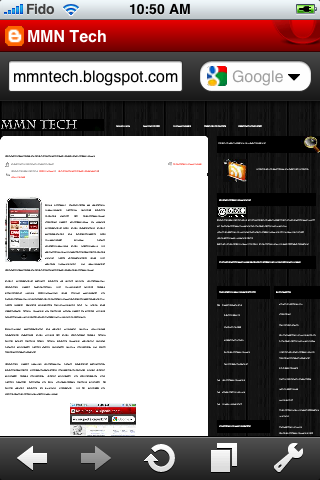 The big difference with Opera is speed. Their servers will compress web pages for you to make them load faster on mobile devices. I tested their claims using the slower EDGE network. MMNTech takes about 59 seconds on Safari. On Opera Mini, it only takes 17 seconds. Big difference. Not all sites are that dramatic but it definitely helps when you're using EDGE to save battery life. On 3G or when using Wifi, the speed up doesn't matter as much. Opera claims this compression can also save on bandwidth, but I didn't test that claim.
Despite all these advantages, Opera Mini is crippled by some major flaws. While Safari can display most web pages flawlessly, Opera struggles. Some pages have formatting problems. Stuff gets moved around or doesn't display properly. When loading Anandtech for example, the entire top navigation bar goes missing, making it impossible to get around the site.
Zooming is also atrocious and imprecise. It won't wrap text on double tap like Safari does. The zoom feature is clunky and a bit too fast for my liking. Opera also seems to have this problem where it will go back or reload the page by itself. I'll type out a forum post, hit done, then it reloads the page and wipes my post out.
Lastly, it lacks auto-correct. Using the iPhone's tiny keyboard is hard enough. You don't realize how much auto-correct helps when you make type-o's. You know, for those of us who don't have child's fingers. So you'll often find yourself going back to fix words that got misspelled.
The biggest problem with Opera is it's just unusable as an everyday browser. I think there's a lot of potential here. It could be a Safari beater with a little time and some patches. But right now, it has too many problems. They need to get working on fixing these issues pronto.
Score: 6 out of 10
What Works:
-Faster than Safari on EDGE
-Innovative user interface
-Adds some features like page saving and in-page text search
What Doesn't Work
-Poor zooming
-Doesn't display some pages correctly that Safari has no problems with
-No auto-correct for spelling
-Does weird things like re-loading pages by itself
 US piracy and counterfeiting estimates have been greatly over estimated.
That's what the Government Accountability Office is saying. The RIAA, MPAA, and the FBI frequently cite the figure of $250 billion and 750,000 jobs lost per year due to copyright theft. The damning report concluded that it was impossible to place a dollar or job figure on looses due to piracy. The GAO concluded that it could not figure out where the FBI had gotten the $250 billion figure.
Pro-IP groups assume that one incident of piracy equals one lost sale. Ars Technia reports that substitution rates, "how much of the infringing activity should be counted as a lost sale", are only based on "assumptions" at best.
The US administration under Bush and Obama has been actively defending the Pro-IP side of the debate. The RIAA and MPAA recently began calling for the government to mandate spyware on computers to automatically detect and delete infringing material. They also want border agents to search travellers' electronic devices and confiscate them if pirated material is found. It's another stepup in their war against piracy that has many online civil rights groups worried.

Is this the end of dedicated PC gaming rigs? Maybe not but OnLive is still trying to offer cloud based online gaming. The system will launch on June 17th, 2010 for Mac and PC at a cost of $15 per month. For that price, gamers will be able to access the service and download its free content such as demos.
However, games will cost extra. Each purchase or rental will carry an extra charge.
OnLive is promising the ability to play games at full 1080p at 60 frames per second using their own networked gaming systems. They're promising that people will be able to play the latest PC games on any system connected to the internet. All the tough rendering work is done back at OnLive HQ while your computer does nothing but handle the internet connection.
As a special offer, OnLive is waving the subscription fee for three months for the first 25,000 subscribers.
Source: Joystiq
I often complain about how Blogger isn't always ideal, with it's weird bugs. Still, it's a lot better than if I did this myself on Dreamweaver. There's a great site called "Webpages that Suck" that claims to show the world's worst. This one I stumbled upon has to take the cake. Done by LA hippie Bella De Soto, the entire site is a garbled mess of left wing political slogans, posters, videos, and other miscellaneous crap. The entire site weighs in at well over 500 megabytes in size and has a hefty resolution of at least 7000x6000. According to WTS writer Vincent Flanders, the site was too big for his screenshot program to take in everything that was there. To give you an idea at how big this is, if you tied four 1080p monitors together in a grid, they still would not be able to show the site in it's entirety. In fact, no monitor in existence would be able to display it on a single screen. It begs the question: how long did this take? More importantly WHY?!
I'll spare readers the link to and just show you the condensed screen shot. A full sized image is available but it will take forever to download.
Are cell phone companies gouging their customers? Myth Confirmed. Adam Savage of Mythbusters fame got a rude awakening after AT&T charged $11,000 in roaming fees for web surfing he did while vacationing in Montreal. The company charges a rate of $0.015/kilobyte for out of country internet usage, which works out to 750 megabytes worth of data. Savage claims he was just using the service to browse a few websites for a couple hours over the entire week long trip and wasn't downloading videos or pictures. Upon getting the shock of his life, the famed special effects artist and TV host posted his complaint on Twitter. It soon became the number two thread following the death of Michael Jackson. After the Twitter complaints stirred up a massive response and his assistant spending hours on the phone with AT&T, the company eventually agreed to drop the charges. “A lot of people on Twitter are saying, ’Well it’s great that it worked for you, because you’ve got 50,000 followers, but what about the rest of us?’ ” Savage said. “And I totally agree with them.”
Adam Savage fights the machine and wins, once again proving his status as the Geek God. In his defence, it is vary hard to use 750mb just surfing web pages. Back when I was in college, we had a 1gb per week allocation for the university wifi. Even listening to internet radio between classes, I never broke 200mb per week. You'd have to be watching a heck of a lot of flash video or downloading vary large files. This whole debacle exposes some major issues with the cell industry and the way it charges customers. For example, I pay $44.95 per month for high speed internet. That gets me 60gb of data transfer, which works out to roughly $0.75 per gigabyte. By contrast, Rogers/Fido's usual 3G data plan costs $30 per month for 1gb. Therefore, using 3G internet costs 40x more than using cable broadband. Furthermore, Cogeco cable also provides me with email service included in the price, something Rogers Wireless does not offer. I admit I do love being able to view web content on the go but I can't help but wonder whether the convenience is worth that much.
I'm not picking on any company in particular here since they all do it. (So Rogers don't sue me.) Savage's dilema shows just how archaic cell companies treat data. While most other service providers charge you by the megabyte or by the gigabyte when you go over your limit, cellular data plans charge per kilobyte. Back in the days of 28kbps dialup internet, this may have been acceptable but to charge per kilobyte in the age of broadband is simply gouging. Roughly speaking, an average five minute song at 256mbps quality off iTunes would cost $0.33 to download over mobile broadband, a third of it's retail value. More shockingly, if you're out of country the same song would cost a whopping $172 under AT&T's roaming fees. By contrast, the same song would cost only $0.008 to download over cable. That gives you something to think about next time you consider downloading songs or apps using 3G on your iPhone.
Phone and text services aren't much better. Fido's cheapest plan costs $0.30/minute ($15 for 50 minutes) while landline local calls are unlimited. Bell Home Phone Lite for example costs $22.95/month for unlimited local calling. Long distance cell rates are $0.35/minute anywhere in Canada. By contrast, $0.15 or less is typical for landlines. VOIP through your cable company usually runs $40 for unlimited local and long distance calling including features such as call display and answering services. For cell phones, these same additional services are usually $5-$10/month extra. Texting is the most costly feature of all, with average price being $0.15 a message with many companies now charging to both send AND receive them. This means you'll also have to pay for any spam received, which is increasingly becoming a problem. A one minute phone conversation costs the same as a single text back and forth. I know I can say a lot more in a minute than I can write in a text. With the average email several paragraphs long being around 20kb, well, you get the idea. It's a heck of a lot cheaper to use conventional services.
So why are mobile services considerably more expensive than their landline counterparts? Cell companies usually try to dodge this question when it is asked. However, there are a couple of legitimate reasons for this. Namely wireless bandwidth is far more limited than wired bandwidth given that cell phones must share the radio spectrum with a gaggle of other devices. Cables using digital transmission don't have this limitation and therefore can accommodate far more people using them at one time. So you pay more for a volatile resource. Cell companies might be able to weakly justify charging double the rate for phone calls but it's vary difficult to do the same thing with text and data services that cost up to fourty times more than vastly superior landlines. The government has already stepped in, threatening to ban receiving charges for texts, and rightly so. Srinivasan Keshav, a leading Canadian based computer scientist estimates that text messages cost cell companies no more than 0.3 cents. That represents a markup of 4,900%. So for every 10,000 texts sent, it costs cell providers $30 but they receive $1,500, equating to $1,470 in pure profit. No other business would get away with that. (Well except maybe a certain company who sells HDMI cables.) Consumers need to start putting the pressure on cell companies to bring their rates down to something that's more comparable with landlines, especially now with so many replacing home phones with their cells. They're gouging, pure and simple. I haven't even begun to rant about the contracts they force you to sign either.
Source: Canada.com
I got a text from FIDO today saying that iPhone owners with Firmware 3.0 will be allowed to tether their phones to a laptop and use it as a 3G Internet stick. The only catch is that you must have a minimum 1gb data plan with the phone, which costs $30 per month. No additional fees apparently, which is good news for those who were concerned that there would be. Unfortunately, Rogers and FIDO still do not offer unlimited data plans like AT&T does. The best plan is $80 a month for a 5gb cap, which is pretty pathetic.
The flight sim community is in mourning this week after the loss of one of the hobby's biggest repositories of addon content for Microsoft Flight Simulator. On May 13th, the site was hacked and it's two servers were brought to their knees. Twelve years worth of content supplied by the site's 60,000 members , including the forums and the file section, were wiped out in minutes. According to the site's administrator Tom Allensworth, restoring content will be extremely difficult if not outright impossible. The attack has left many in the tech community scratching their heads. One commenter on The Register was confused as to why an attack of this magnitude would be launched against a non-commercial hobby site. Indeed, there is no financial gain to be made by simply deleting data. Some speculate that it could be a test for a larger attack or was possibly done by a disgruntled staff/site member. Nobody has claimed responsibility so far at the time of writing. In the wake of the disaster, Allensworth has come under fire by those in IT for Avsim's purportedly lax security. While Allensworth claims there were no successful hack attempts on the site in its history, server experts have questioned why no offline backups were ever made. Avsim did have a duplicate server but that data was also online, making it an easy target for any hacker able to break into the main server. Using duplicate servers is a common form of redundancy in case of hardware failure but it is not a substitute for proper backups. "Mark" of UK based flight simulation news site FlightSimX, who is donating bandwidth for a possible resurrection of Avsim, laid blame directly on Avsim's administrators for not adequately securing their data.
Currently, Avsim still exists as a temporary web forum but those looking to download files are out of luck. The forum provides more information on the hack as well as progress for getting the site restored. Users will have to sign up again since old user names and passwords no longer work. I've been a member of Avsim for a long time and even though I really don't use FS that often anymore, it's sad to see it go. However, I agree with FlightSimX that the site's administrators should have known better. Hopefully Avsim's many content providers were smart enough to keep backups of their own work and are willing to upload it again should the site be restored. There's an important lesson is to be learned from this. Always backup your important data. Even if you're unlikely to be hacked, computers aren't perpetual machines; they do fail.
Source: The Register
Yeah, I've been posting a lot of crap lately. I am working on some legitimate articles but the writing process has been slow. I came across this and thought it was funny. Yes, this is real. You can try it for yourself.
see more pwn and owned pictures
I'm not sure why Google Suggest is so terrified of the Chinese. Then again, this might have something to do with it.
Eccentric UK tech site The Register (aka El Reg) is well known for their off beat sense of humour. In an article today, the site likens the modern music industry to 12th century feudal kingdoms. Surprisingly, this is not much of a stretch.
Read it here.
Stardock and Gas Powered Games have created a Gamer's Bill of Rights. As readers will know, I've praised Stardock in the past for their user friendly and DRM free gaming experiences. They have been highly critical of the industry and the general attitude that legitimate gamers need to be clamped down on to prevent rampant piracy. Previously, the company was quite frank in saying that if you make a game that's good and sell it for a fair price, people will buy it. The "bill" contains 10 rights that Stardock and Gas Powered believe that PC gamers should have, as published on Edge by Stardock's Brad Wardell.
- Gamers shall have the right to return games that don't work with their computers for a full refund.
- Gamers shall have the right to demand that games be released in a finished state.
- Gamers shall have the right to expect meaningful updates after a game's release.
- Gamers shall have the right to demand that download managers and updaters not force themselves to run or be forced to load in order to play a game.
- Gamers shall have the right to expect that the minimum requirements for a game will mean that the game will adequately play on that computer.
- Gamers shall have the right to expect that games won't install hidden drivers or other potentially harmful software without their express consent.
- Gamers shall have the right to re-download the latest versions of the games they own at any time.
- Gamers shall have the right to not be treated as potential criminals by developers or publishers.
- Gamers shall have the right to demand that a single-player game not force them to be connected to the Internet every time they wish to play.
- Gamers shall have the right that games which are installed to the hard drive shall not require a CD/DVD to remain in the drive to play.
1. The days of burn and return are long over when its simply easier to download something off a torrent. For some reason, it became part of copyright law that "intellectual property" cannot be returned for refund at a store regardless of whether it is faulty or not. It can only be exchanged for another copy of the same thing. Some stores like EB skirt around this law by allowing gamers to trade in games for store credit, though at lesser value of what they originally paid. PC games have historically been valued much lower than console counterparts. This basically allows developers to sell faulty products without consequence.
2. The patch thing I mentioned before. Many PC games are released with mountains of bugs. What you get in box basically amounts to a public beta. Gamers then report problems to the company and patches are (hopefully) released. I talked about this in depth previously.
3. Meaning patches that work to actually fix issues and/or add new content. UBI's Blazing Angles is an infamous example of how not to do this. They actually gave up on patching it.
4. More of an irritant than anything else but I don't consider this a major issue.
5. Back we are to Lock on: Modern Air Combat. Perhaps my most hated game. The game ran at slide show speeds despite me exceeding the recommended requirements. Microsoft Flight Simulator also has this problem. There is no way you could possibly enjoy the game with the minimum requirements FSX lists. For example, it lists as minimum, a Pentium 4 1.0ghz or equivalent, 256mb RAM for Windows XP, and DX9 video card with 32mb ram. I have an Athlon X2 3800+, 2gb of RAM on Windows XP, and a Radeon HD 3850 256mb card and yet the game still struggles and cannot be run on full settings. On a minimum system, the game would be a blur. Crysis is yet another example.
6. Starforce and SecuROM are two DRM schemes used in PC gaming. They have received a lot of flack for installing drivers, spyware, and registry keys that often cannot be removed from a system even if the game has been uninstalled. Technically, it's illegal to install software on someone's computer without their consent. Of course, you give this consent by agreeing to the EULA, which nobody reads or understands. That's how they skirt the law. These DRM schemes have been known to do unintended damage to a system or trigger false alarms. As such, people actually turn to pirated copies of games they bought just to get around these damaging DRM schemes.
7. Basically saying that gamers should be able to obtain patches or download new versions of downloadable content without fees.
8. Digital Rights Management has been getting more intrusive over the years. At one point not too long ago, all it required you to do was type in a software key at the back of the manual. More recently, its started phoning home to make sure you're not pirating the game. When Mass Effect and Spore were announced, they were going to phone home weekly to keep checking for piracy. Not only is this ridiculous, it's an invasion of privacy and basically labels all gamers as potential criminals.
9. Goes with #8 and the whole phoning home debacle. If you're on a laptop and not near a Wifi hotspot, some of your games may not be playable because they can't connect to DRM servers. Criminalizes mobile gamers.
10. Another thing that criminalizes mobile gamers. Most games once they install on the HDD don't require any more data from the DVD. It's basically a measure to make sure you're not sharing your games with friends. You can actually take the CD/DVD out of the drive when the game starts up and it will not effect play at all. With all the DRM schemes they put on the system when you install the game, why is a disc check still required? For desktop gamers, this isn't a big issue since it's no different from console gaming but mobile gamers don't want to carry around stacks of discs.
Source: Edge-Online
I'm not a big music buff. When I do listen to it, I usually listen to it on the radio (or satellite radio) or from physical media such as CDs or vinyl. I rip audio from those physical sources to my MP3 player in high quality 320kbps AAC files for listening on the go. I have never purchased digital music (not to be confused with CDs despite them technically being digital as well). DRM has always been the overwhelming flaw with the way digital music is distributed. As you probably know, Digital Rights Management restricts what you can do with a song such as the number of times it can be copied to another device, and even what devices it can be copied too. The whole concept was (supposedly) developed to stop music and video piracy. However, many users who bought the songs without realizing they were protected, or the extent of how they are protected have been getting a rude awakening. DRM on songs stored on your computer are subjected to a license. You have paid for the song but technically, you are only renting it. Each song has a license embedded in it. It communicates with a central server that determines that you are allowed to use said song on that specific system. Now here's the issue. What would happen if the retailer chose to shut shut down their licensing server. That's what now defunct MSN Music did. Now Yahoo Music is going to do the same. What this means is that the DRM embedded in the song can't find out if your are its rightful renter and therefore, it locks down the file. You've paid for something that is now totally useless.
There is a work around, being to burn the songs to CDs. This strips them of their DRM but reriping them lowers their already low quality further. Also, this is technically illegal to do under the United States' DMCA as it is considered circumventing copy protection. Yahoo is telling its users to do this anyway despite that fact. CNet's Digital Media blog brought up an interesting concept though. What if Apple shut down the iTunes licensing servers. It seems impossible but remember that Microsoft and Yahoo are huge companies as well. If they ever did, more than 1 billion songs would go down the drain. It would be a PR nightmare but the iTunes Store terms of service specifically states that Apple cannot be held responsible should this happen. Therefore, customers would be shit out of luck. You really did get what you pay for. As I noted above, most people don't even realize that music is not theirs to own. You're just leasing it. Unlike auto leases and such, you don't have vary many legal rights when leasing music. This is the fundamental flaw with digital distribution and the reason why I would never buy songs from iTunes. As I have said before, I think it's high time DRM be banned. All it serves to do is abuse legal customers. In the mean time, you should purchase your music on CD, vinyl LP, or from trusted DRM-free music services like Amazon. If you choose to buy DRM ladden products, you're taking a gamble with your investment.
Wow, I must have been living under a rock because this is the first time I've heard of this. Well, apparently Sony ran into some trouble with the service that was supposed to be due out in July but is now planned for release this month. (Is it August already? Summer goes by WAY too fast) If you're as confused as I am, let me give you the run down that I found on PC World. The service is similar to Nintendo's Wii Channels. A 3D globe interface will list regions and cities. From what I can tell, the interface will be similar to Google Earth, using weather satellites for the image. You'll be able to get weather and news headlines for major cities using the service. The news service appears to be similar to RSS feeds. Clicking headlines will open that page in the browser, which according to PC World is different from Nintendo's which relies on content partners. Music stored on the hard drive can be played in the background of the interface and will either play user defined playlists or shuffle what's there.
It's certainly far more usefull than the halfassed ticker that was added in Firmware 2.0, which of course only displayed Playstation news. There is currently no set release date for Life with Playstation other than it will arrive sometime in August 2008.
With HDTVs becoming more common place, I think this is the way things are moving. People already want and get their information on demand. All the better if it's always there without having to turn on your computer. I expect this type service will eventually be integrated right into TVs but for now, game consoles are doing jobs that nobody had ever intended them to do even just 10 years ago.
